Kitchener DriveTest Test Route Map
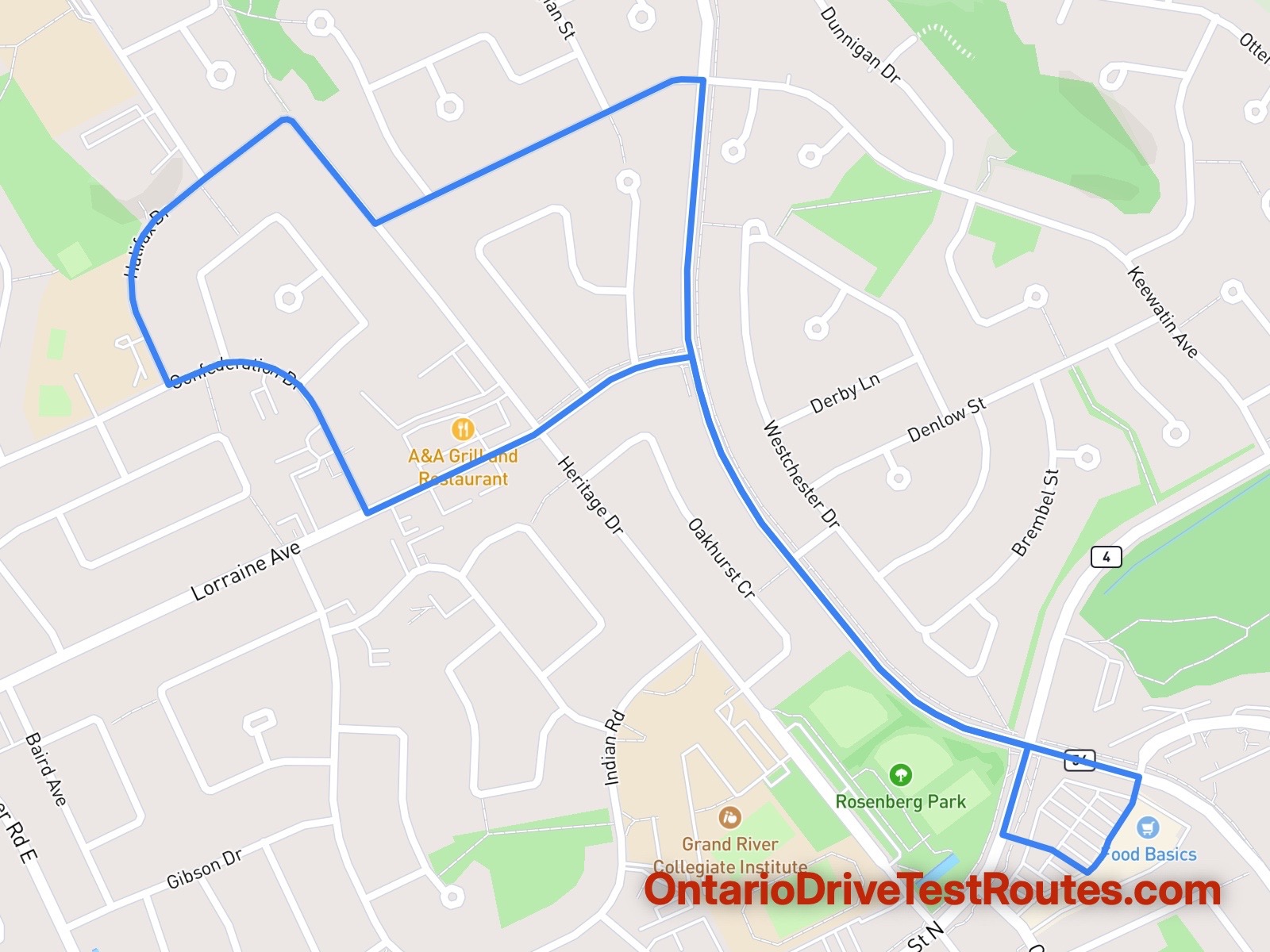
11 mins
Route Duration
4.25 km
Route Length
Kitchener DriveTest
Location
Turn-by-Turn Directions
| # | Instruction | Distance | Duration |
|---|---|---|---|
| 1 | Drive southwest. | 0.00 km | 1 min |
| 2 | Turn right. | 0.12 km | 1 min |
| 3 | Turn right onto Ottawa Street North/RR 4. | 0.01 km | 1 min |
| 4 | Drive north on Ottawa Street North/RR 4. | 0.11 km | 1 min |
| 5 | Drive east on Ottawa Street North/RR 4. | 0.00 km | 1 min |
| 6 | Make a sharp right onto Lackner Boulevard/RR 54. | 1.07 km | 2 mins |
| 7 | Drive south on Lackner Boulevard/RR 54. | 0.00 km | 1 min |
| 8 | Turn right onto Keewatin Avenue. | 0.47 km | 1 min |
| 9 | Drive northwest on Keewatin Avenue. | 0.18 km | 1 min |
| 10 | Turn left onto Halifax Drive. | 0.45 km | 1 min |
| 11 | Turn left onto Confederation Drive. | 0.07 km | 1 min |
| 12 | Drive east on Confederation Drive. | 0.30 km | 1 min |
| 13 | Turn left onto Lorraine Avenue. | 0.10 km | 1 min |
| 14 | Drive northeast on Lorraine Avenue. | 0.37 km | 1 min |
| 15 | Drive south on Lorraine Avenue. | 0.85 km | 1 min |
| 16 | Turn right. | 0.14 km | 1 min |
| 17 | Your destination is on the left. | 0.00 km | 1 min |
Disclaimer: This sample route is for demonstration purposes only and does not represent the actual test routes used during the test. Accurate Kitchener DriveTest driver test routes are available with your purchase.
Kitchener DriveTest DriveTest Centre
Address
Kitchener DriveTest DriveTest
1405 Ottawa St N
Unit 112
Kitchener
ON N2A 3Z1
Phone: 1-888-570-6110
Opening Hours
- Monday: 7:00 AM – 7:00 PM
- Tuesday: 7:00 AM – 7:00 PM
- Wednesday: 7:00 AM – 7:00 PM
- Thursday: 7:00 AM – 7:00 PM
- Friday: 7:00 AM – 7:00 PM
- Saturday: 8:30 AM – 5:00 PM
- Sunday: Closed
Tests Offered
Public: G2 | G | M2 | M | LM2 | LM
Commercial: A | B | C | D | E | F | Z
Pass Rates:
G Test: 68%
G2 Test: 69%
Other Ontario Drive Test Centres
- Arnprior DriveTest
- Bancroft DriveTest
- Barrie DriveTest
- Belleville DriveTest
- Brampton DriveTest
- Brantford DriveTest
- Brockville DriveTest
- Burlington DriveTest
- Chatham DriveTest
- Clinton DriveTest
- Cornwall DriveTest
- Downsview DriveTest
- Dryden DriveTest
- Espanola DriveTest
- Etobicoke DriveTest
- Fort Frances DriveTest
- Guelph DriveTest
- Hamilton DriveTest
- Hawkesbury DriveTest
- Huntsville DriveTest
- Kapuskasing DriveTest
- Kenora DriveTest
- Kingston DriveTest DriveTest
- Kirkland Lake DriveTest
- Lindsay DriveTest
- London DriveTest
- Mississauga DriveTest
- New Liskeard DriveTest
- Newmarket DriveTest
- North Bay DriveTest
- Oakville DriveTest
- Orangeville DriveTest
- Orillia DriveTest
- Oshawa DriveTest
- Ottawa Canotek DriveTest
- Ottawa Walkley DriveTest
- Owen Sound DriveTest
- Peterborough DriveTest
- Renfrew DriveTest
- Sarnia DriveTest
- Simcoe DriveTest
- Smiths Falls DriveTest
- St. Catharines DriveTest
- Stratford DriveTest
- Sudbury DriveTest
- Thunder Bay DriveTest
- Tillsonburg DriveTest
- Timmins DriveTest
- Toronto Metro East DriveTest
- Toronto Port Union DriveTest
- Walkerton DriveTest
- Winchester DriveTest
- Windsor DriveTest
- Woodstock DriveTest
Understanding Ontario’s G Licensing System in Kitchener
Are you a novice driver seeking to obtain your initial driver’s license? Or perhaps you are a parent who is uncertain about the necessary steps for your child to acquire a license. Understanding the progression from a G1 to a G2 to a full G license is essential for navigating Ontario’s G licensing system.
To aid in your success, these Kitchener drive test videos will assist you in passing your G Full license on the first attempt. Through consistent practice, you will develop the necessary skills and confidence to safely operate a vehicle on the highway.
The following information delves into the rules, requirements, and restrictions of G1, G2, and G driver’s licenses, as well as addressing commonly asked questions.
What Is A Graduated Driver’s License?
Inexperienced drivers, particularly those in the youthful demographic, are disproportionately represented in motor vehicle accidents. This demographic has the highest driver fatality rate and presents the greatest level of risk on the road. To address this issue, the Graduated Licensing Program (GDL) in Ontario was implemented.
The GDL in Ontario provides a structured framework for young drivers to acquire essential driving experience over a gradual period. This system creates a protective environment for novice drivers, enabling them to develop their driving skills and knowledge as they progress through the graduated licensing system. The GDL has been in effect in Ontario since 1994, and has been successful in reducing accidents among young drivers.
Definition
The Graduated Driver’s Licensing (GDL) system is a comprehensive approach utilized in Ontario and across Canada to assist novice drivers in acquiring the necessary experience to become proficient operators of motor vehicles. The GDL typically comprises three distinct stages, including a learner’s permit, a probationary license, and a full driver’s license.
Ontario’s G License System Has 3 Levels
Acquiring a full G license in Ontario requires adherence to the established requirements at each stage of the Graduated Driver’s Licensing (GDL) system, which progresses from G1 to G2, culminating in the attainment of a full G license. This gradual progression is the foundation of Ontario’s GDL system, which is designed to ensure that drivers possess the necessary skills and knowledge to safely operate a motor vehicle at each level before progressing to the next stage.
This approach is commonly referred to as a graduated licensing program, as it requires the driver to successfully “graduate” from one level to the next.
Ontario Driver’s License G Classes
The graduated driver’s license system in Ontario has three classes of licensing:
- G1 license
- G2 license
- Full G license
The Full G License
About Getting Your G License
Attainment of a full G license in Ontario represents the culmination of the Graduated Driver’s Licensing (GDL) process. The acquisition of a full license removes the majority of driving restrictions and grants the holder the freedom to operate a motor vehicle on all roads at any time. Obtaining a full G license not only grants a sense of liberation, but also provides a sense of completion, as the driver is no longer subject to additional road tests and may be eligible for lower car insurance rates.
Is Taking a Drive Test Exam in Kitchener a Good Idea for a Higher Chance of Passing?
The latest percentage passing rates for the DriveTest Centre in Kitchener, Ontario, are near the provincial average:
- G Road Test: The pass rate is 68%, which translates to a failure rate of 32%.
- G2 Road Test: The pass rate is 69%, with a failure rate of 31%.
Kitchener: Tech-City Growth, Ottawa Street, and the Waterloo Region Driving Environment
Kitchener forms one half of the Kitchener-Waterloo twin cities, a region that has emerged as one of Canada’s most dynamic technology and innovation corridors — often called “Canada’s Silicon Valley.” Rapid population growth driven by the tech sector, the University of Waterloo, Wilfrid Laurier University, and Conestoga College has produced a dense, multi-modal urban environment with growing traffic volumes on key corridors such as Ottawa Street North, Fairway Road, Highland Road, and the Ira Needles Boulevard.
The DriveTest Centre at 1405 Ottawa Street North, Unit 112, sits at the eastern edge of Kitchener near the Fairway Road intersection. Test routes from this centre span a broad swath of Kitchener’s east and central suburbs, incorporating Ottawa Street, Lackner Boulevard, Wilson Avenue, Highland Road West, Fischer-Hallman Road, and Westmount Road. These routes present a mix of 50–80 km/h multi-lane arterials with active signal intersections, suburban residential sections, and light commercial zones.
Compared to nearby Guelph (63% G and G2 pass rates), Kitchener performs somewhat better at 68% and 69% respectively — a modest but meaningful difference. Both centres are in the same region and serve a similar demographic of university-area and suburban drivers. Brampton, by contrast, has far lower pass rates (47% G2), reinforcing Kitchener’s position as a mid-tier centre offering reasonable odds for well-prepared candidates.
The extended hours — Monday through Friday 7:00 AM to 7:00 PM, plus Saturday morning service — provide excellent scheduling flexibility, making Kitchener one of the more accessible centres in Ontario.
Comparison with Other Ontario Locations:
Lower Pass Rate Locations:
- Brampton: G2 pass rate of 47% (53% failure rate); G pass rate of 59% (41% failure rate)
- Guelph: G2 pass rate of 63% (37% failure rate); G pass rate of 63% (37% failure rate)
Higher Pass Rate Locations:
- Kenora: 93% G2 pass rate (7% failure rate)
- Huntsville: 82% G pass rate (18% failure rate)
- Kingston: 72% G pass rate (28% failure rate)
Kitchener falls in a mid-range tier — better than the GTA centres and Guelph, but below the provincial leaders. For Waterloo Region residents, Kitchener is the most practical choice given geographic familiarity with the local road network.
Characteristics of the Kitchener DriveTest Centre:
Testing Environment:
- Multi-lane suburban arterials with moderate to heavy peak-hour traffic
- Ottawa Street North and Fairway Road as primary commercial corridors
- Lackner Boulevard and Westmount Road for higher-speed suburban transitions
- Fischer-Hallman Road and Ira Needles Boulevard for newer suburban areas with roundabouts
- Highway 7/8 and the 401 spur accessible for G test highway driving
Common Test Route Elements:
- Ottawa Street North as the starting corridor from the test centre
- Lackner Boulevard for suburban arterial driving with lane changes
- Wilson Avenue and Highland Road for central Kitchener navigation
- Fischer-Hallman Road and Westmount Road for west Kitchener suburban sections
- Ira Needles Boulevard for roundabout and multi-lane arterial practice
Recommendation:
Kitchener is the logical choice for residents of the Waterloo Region. Pass rates at 68–69% are slightly above the provincial average and meaningfully better than nearby Guelph and the GTA centres. The centre’s extended hours and Saturday availability give candidates more flexibility than most Ontario locations. Thorough preparation on Ottawa Street, Lackner Boulevard, and Highland Road — combined with practice in roundabout navigation for the Ira Needles corridor — will position candidates for success at this active, growing test centre.